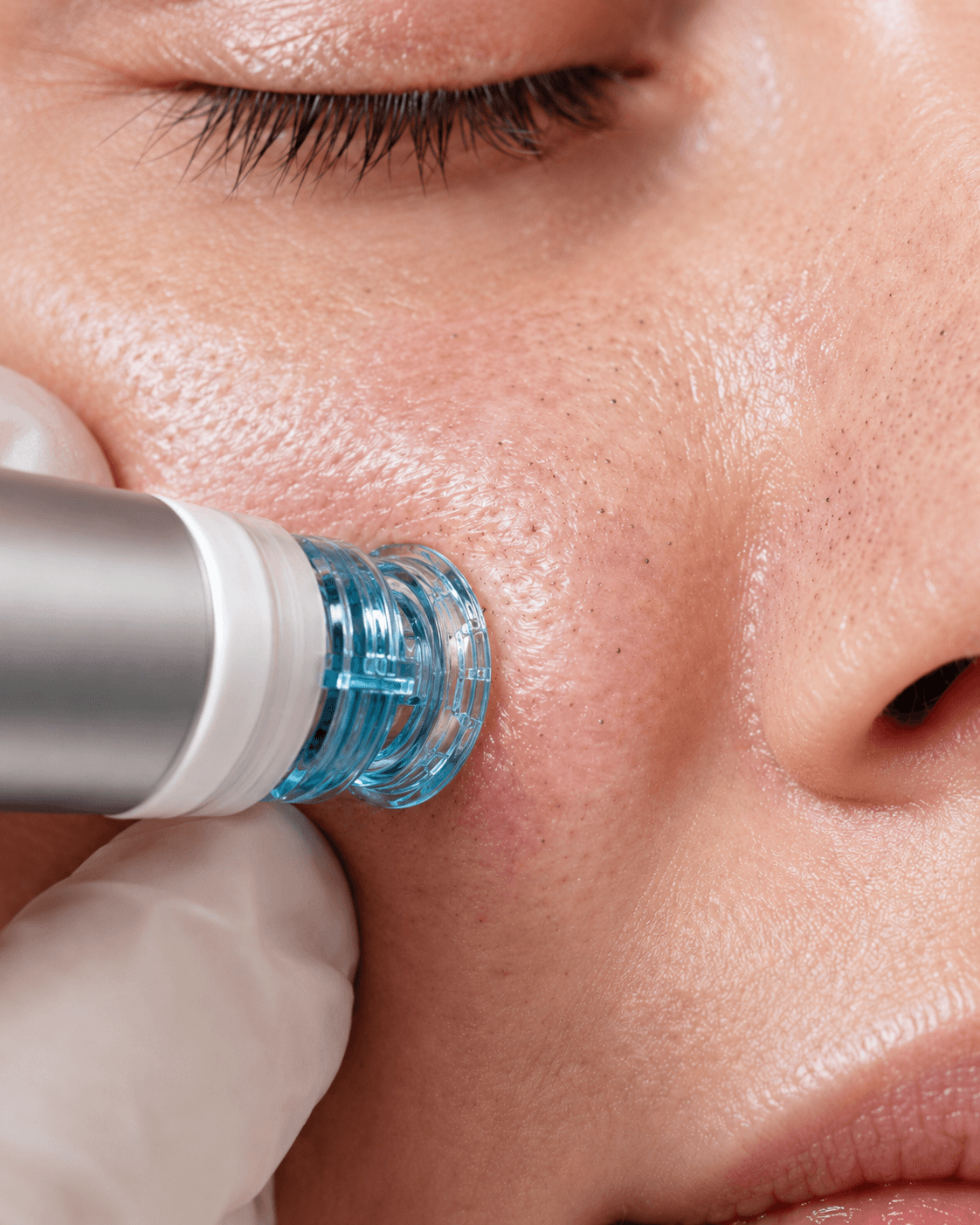
If you’ve been researching non-surgical skin tightening lately, you’ve probably run into two names: Sofwave and Xerf. Both promise to lift and firm skin without surgery, needles, or downtime — and right now, Xerf is generating a lot of buzz. But buzz isn’t the same as proven, and the two treatments work in fundamentally different ways. At Healthy Glow Aesthetics in Fort Lauderdale, we offer Sofwave, and we get asked about the difference almost daily. This is an honest, side-by-side look at how each one works, where they differ, and why we made the choice we did.
What Is Sofwave and How Does It Work?
Sofwave is an FDA-cleared, non-invasive skin-tightening treatment that uses ultrasound energy to stimulate your body’s own collagen. Its SUPERB technology (Synchronous Ultrasound Parallel Beam) delivers seven focused ultrasound beams at once to one exact depth — 1.5mm in the mid-dermis — the precise layer where your skin produces new collagen and elastin. Every pass reaches the same controlled depth, not a range.
That precision extends to temperature. Sofwave heats the target layer to a specific, controlled range that triggers collagen remodeling, while an integrated cooling system holds the surface temperature down to protect the skin throughout. Fixed depth, controlled heat, protected surface — the whole treatment is engineered around delivering energy to exactly one place and no further.
At that depth, the energy creates controlled heat zones that trigger your natural healing response, a process called neocollagenesis. Over the following weeks and months, that new collagen firms and lifts the skin, with little to no downtime. Sofwave is FDA-cleared to lift the eyebrows, tighten the neck and submental area (under the chin), and improve the appearance of fine lines and wrinkles, with most patients seeing results within about three months of a single session.
What Is Xerf and How Does It Work?
Xerf is a newer treatment that uses radiofrequency (RF) energy rather than ultrasound. Specifically, it’s a dual-frequency monopolar RF system, developed in South Korea, that combines two frequencies to deliver heat across the superficial, mid, and deep layers of the skin, including the deeper structural layer.
Like Sofwave, the goal is to heat tissue enough to stimulate collagen and elastin. Xerf arrived on the U.S. market recently and has attracted significant attention, including celebrity endorsements and a wave of coverage. It’s a legitimate, FDA-cleared technology. The important context is simply that it’s new here, and its long-term track record in the U.S. is still being established.
What’s the Core Difference Between Sofwave and Xerf?
The single biggest difference comes down to the type of energy each one uses: Sofwave is ultrasound, Xerf is radiofrequency. That’s not a marketing distinction — it changes how the energy travels through the skin, how predictable the results are, and how the treatment behaves across different skin tones.
This difference shapes how precisely each treatment can be controlled. Sofwave’s ultrasound targets one fixed depth with every pass and largely bypasses the surface, so the energy goes to a defined layer and stops there. Xerf’s monopolar radiofrequency works differently by design: the energy travels through the tissue toward a grounding point on the body, creating a broad, deep thermal field across multiple layers rather than concentrating at a single depth. Both build collagen, and both use surface cooling. But one delivers energy to a precise, fixed target, and the other spreads heat more broadly through the tissue — and when it comes to predictability, precision matters.
Why Does the Type of Energy Matter?
Is Sofwave or Xerf Better for Different Skin Tones?
This is one of the most important differences, especially in a diverse community like Fort Lauderdale. Because Sofwave’s ultrasound energy bypasses the surface of the skin and targets the mid-dermis directly, it carries minimal risk of pigment changes and is considered safe across all skin types and tones. That makes it a reliable option for deeper skin tones, where some energy-based treatments carry a higher risk of discoloration.
Radiofrequency treatments can be performed on a range of skin tones as well, but as with any energy device that heats the skin, careful settings and an experienced provider matter a great deal in reducing the risk of pigment change or irritation.
How Established Is Each Treatment?
Track record is where the two diverge most, and it comes down to the depth of human evidence behind each one. Sofwave has been used in hundreds of thousands of treatments worldwide and is backed by published human clinical data, including a pivotal trial in which blinded reviewers found meaningful improvement in lines and wrinkles at 12 weeks. It has been in the market long enough to have a well-understood safety and results profile in real patients.
Xerf, by contrast, only received FDA clearance in August 2025. It’s a legitimate technology, but much of the science behind its headline structural and depth claims comes from preclinical animal (porcine) studies, with human evidence still limited to small, early trials and studies now underway. That’s a normal stage for a new device — but it’s an important distinction. When a treatment leans heavily on animal-model data and celebrity attention rather than years of human outcomes, “proven” isn’t quite the right word yet. Newer isn’t automatically better, and for a treatment you’re investing in, a deep body of human evidence carries real weight.
What About Predictability and Results?
Sofwave’s parallel-beam design delivers energy uniformly at the same fixed depth and controlled temperature with every pass — which is exactly what supports consistent, predictable results from one session and one provider to the next. With any collagen-stimulating treatment, results build gradually over three to six months and can last a year or longer. Honest providers of both treatments will tell you the same thing: these are treatments for mild to moderate skin laxity, and neither one replaces a surgical facelift or restores lost facial volume.
Is Xerf Safe? Understanding the Noise
It’s worth addressing directly, because it’s a common question. Xerf is FDA-cleared and, performed correctly, is considered a safe treatment. The concerns circulating about it are less about the device itself and more about two things: it’s new, and radiofrequency results depend heavily on the skill of the person operating it.
Radiofrequency delivers heat through the skin, and in less experienced hands, or at the wrong settings, RF treatments carry a rare but real risk of burns, blistering, or pigment changes. This isn’t unique to Xerf — it’s true of the entire category. The takeaway isn’t “Xerf is dangerous.” It’s that with any energy-based treatment, and especially a newer one, the provider and the technology’s track record matter enormously. That’s precisely the lens we applied when deciding what to offer.
Why Healthy Glow Aesthetics Chose Sofwave
We looked at the landscape and chose Sofwave deliberately, for reasons that come down to trust:
Its ultrasound technology delivers energy to one fixed depth at a controlled temperature, which makes results consistent and predictable. It’s proven in a large body of published human research and hundreds of thousands of real treatments, not primarily animal studies. It’s safe across all skin types and tones, which matters for the clients we serve here in South Florida. And it has an established safety profile rather than one still being written.
We’re not against innovation. When a newer treatment proves itself over time, we pay attention. But for a treatment our clients trust us with, we chose the one with the longest track record and the most predictable outcomes, and we’d rather let our results speak than chase the newest name.
What Can You Expect From Sofwave at Healthy Glow?
A single Sofwave session is comfortable, with most clients describing brief pulses of warmth. There are no needles, no numbing required for most, and no downtime, so you return to your day immediately. Results develop gradually as new collagen forms, typically becoming visible around the three-month mark and continuing to improve from there. For most clients, results last a year or longer, which is why an annual maintenance session keeps skin looking its best.
Sofwave vs. Xerf at a Glance
- Energy type — Sofwave: Ultrasound (SUPERB). Xerf: Radiofrequency (dual-frequency monopolar).
- How it targets skin — Sofwave: One fixed depth (1.5mm), controlled temperature, bypasses the surface. Xerf: Broad thermal field across multiple layers.
- Precision — Sofwave: Same depth and heat every pass. Xerf: Energy spreads through tissue toward a grounding point.
- Human evidence — Sofwave: Published human trials, hundreds of thousands of treatments. Xerf: FDA-cleared Aug 2025; structural claims largely from animal studies, human data still early.
- Skin tones — Sofwave: Safe across all skin types, minimal pigment risk. Xerf: Requires careful settings on deeper tones.
- Downtime — Both: Little to none.
- Results timeline — Sofwave: Builds over ~3 months, lasts a year+. Xerf: Builds over months, varies.
- Best for — Sofwave: Mild to moderate laxity, fine lines, lifting. Xerf: Mild to moderate laxity.
Frequently Asked Questions
Q: Is Sofwave or Xerf better?
They use different energy — Sofwave is ultrasound, Xerf is radiofrequency — and both aim to build collagen. Sofwave has a longer track record, is safe across all skin tones, and delivers consistent results, which is why we offer it. The right choice always depends on your skin, your goals, and the experience of your provider.
Q: What’s the main difference between Sofwave and Xerf?
Sofwave uses focused ultrasound that targets one fixed depth at a controlled temperature and bypasses the skin’s surface. Xerf uses monopolar radiofrequency that spreads heat more broadly through multiple layers. Sofwave also has a deeper body of published human evidence, while much of Xerf’s structural data so far comes from animal studies. Those differences affect predictability and safety across skin tones.
Q: Is Xerf safe?
Xerf is FDA-cleared and considered safe when performed correctly. As with all radiofrequency treatments, results and safety depend significantly on the provider’s skill and the settings used.
Q: Does Sofwave hurt?
Most clients describe brief pulses of warmth. It’s well-tolerated, requires no downtime, and you can return to normal activities immediately.
Q: When will I see results from Sofwave?
Results develop gradually as your body produces new collagen, usually becoming visible around three months and continuing to improve, with results lasting a year or longer for most clients.
Q: Is Sofwave safe for darker skin tones?
Yes. Because the ultrasound energy bypasses the surface and doesn’t rely on pigment, Sofwave carries minimal risk of pigment changes and is considered safe across all skin types and tones.
Final Thoughts
New treatments will always generate excitement, and Xerf is a legitimate technology worth watching. But when it comes to trusting a treatment with your skin, a proven track record, predictable results, and safety across every skin tone matter more than being the newest name in the room. That’s why Healthy Glow Aesthetics in Fort Lauderdale chose Sofwave. If you’re considering non-surgical skin tightening and want to know whether Sofwave is right for you, the best next step is a consultation, so we can assess your skin and build a plan around your goals.